
How to Paint Hokusai's Great Wave (and the Story Behind It)

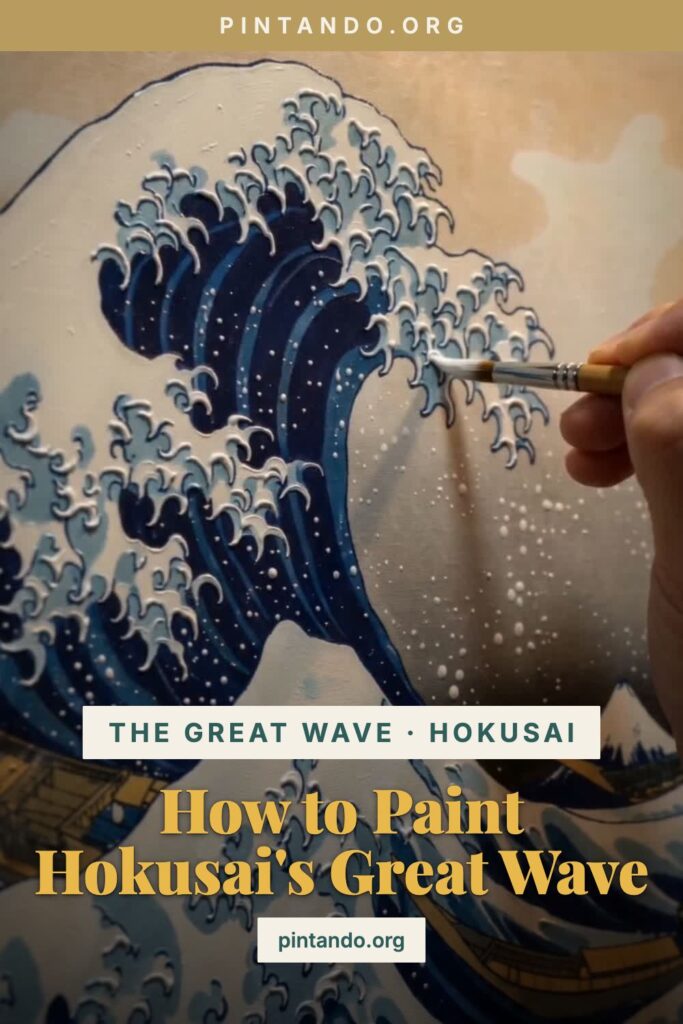
How to Paint Hokusai's Great Wave — and the Surprising Story Behind It
It's the most famous wave in the world, and almost nothing people assume about it is quite right. Hokusai's Great Wave isn't a painting — it's a woodblock print. It isn't really about the wave — it's about the mountain. And the artist who made it was around seventy years old and convinced he still hadn't figured out how to draw. Once you know what you're looking at, painting your own version becomes far more interesting than just copying a famous picture.
The full title is Under the Wave off Kanagawa (c. 1831), and it was the opening image of Hokusai's series Thirty-Six Views of Mount Fuji. That's the twist most people miss: the whole series — and this image — is about Mount Fuji. The wave is the drama, but Fuji is the subject, sitting small and calm and permanent in the distance while the sea rears up in front of it. The wave's foam claws even echo Fuji's snow-capped shape. Miss the mountain and you've missed the whole point.
A print, not a painting
Because it looks so painterly, people imagine Hokusai at an easel. He wasn't. The Great Wave is ukiyo-e — a color woodblock print. Hokusai designed the image; specialist craftsmen carved the woodblocks and pulled the prints by hand, one color at a time. It was made to be reproduced and sold cheaply, and thousands of impressions were printed over the years (only a few hundred well-preserved ones survive). That deep, unforgettable blue came from Prussian blue, a synthetic pigment newly imported from Europe — Hokusai was among the first ukiyo-e artists to build a picture around it.
So when you paint the Great Wave in oils or acrylics, you're doing something Hokusai never did: turning a print into a painting. That's freeing. You're not forging a masterpiece; you're translating one.
What actually makes it work
Strip away the fame and the Great Wave is a lesson in three things any seascape needs:
- Negative space. Huge areas do almost nothing — pale sky, flat blue troughs — so the one big gesture reads like a shout. Beginners overfill; Hokusai leaves the canvas room to breathe.
- The claw. The foam at the crest breaks into finger-like claws reaching over the boats. That repeating, rhythmic shape is the signature. Paint it deliberately — it's drawing, not splatter.
- Scale by contrast. Tiny boats, tiny mountain, gigantic wave. The smallness of Fuji is what makes the wave enormous. Keep Fuji small.
How to paint your own Great Wave
- Draw the big curve first. Lightly sketch the wave's arc and the smaller swell in front. Place Mount Fuji small, low, and to the right, inside the curl.
- Block the blues. Deepest Prussian/Ultramarine blue in the body of the wave, lighter blue in the troughs, pale warm sky. Leave the sky mostly empty.
- Build the foam edges. Where the wave breaks, lay white and pull it into the curling claw shapes. Let them reach.
- Flick the spray. Tiny white dots scattered off the crest — drag or flick them so they feel like spray, not polka dots.
- Keep Fuji quiet. A small calm triangle, a touch of snow highlight. Resist making it bigger. Its stillness is the whole drama.
New to painting water? It's worth getting comfortable with easy rolling waves first — the same value-and-foam logic, with none of the pressure of a masterpiece — then come back for the Great Wave.
If your version feels busy, you've filled the quiet areas — scrape some back and let the sky and troughs stay empty. The Great Wave is loud because so much of it is silent. Hokusai spent a lifetime learning that restraint; he once wrote that if he could keep working, by a hundred he might finally make pictures that were truly alive.
This is the first of a little famous-seascapes series — next I take on Aivazovsky's glowing Ninth Wave, a completely different way to paint the sea. Whose sea should I paint after that?
You might also enjoy these articles: