
Painting Blueberries the Wrong Color | Watercolor

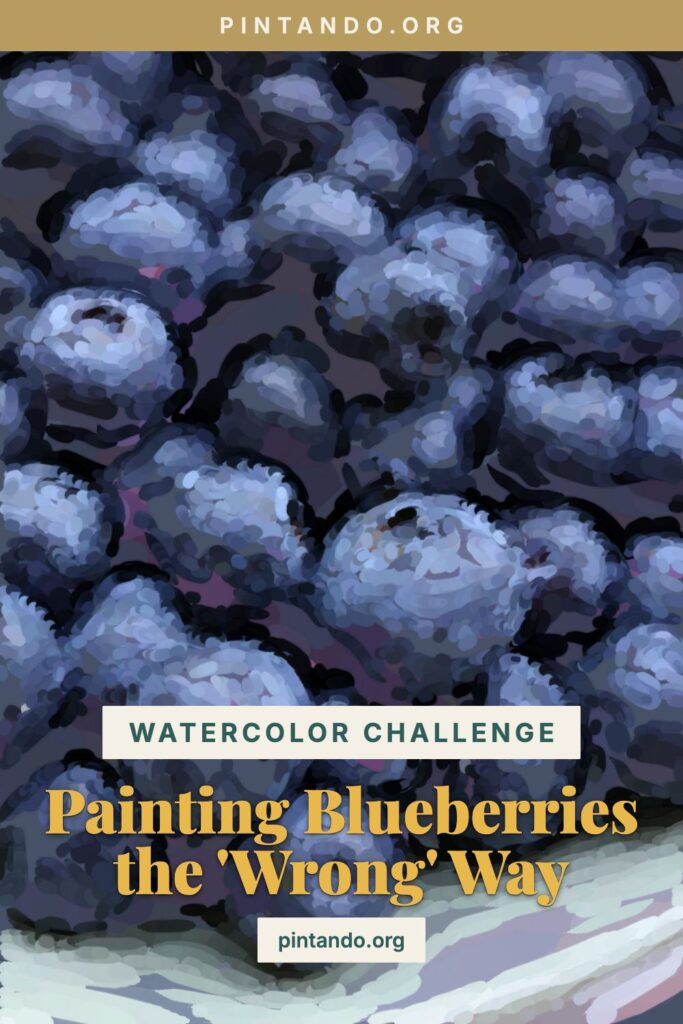
Painting Blueberries the Wrong Color (Because Blue Is the Hardest One to Get Right)
In the video, a handful of blueberries begins in completely the wrong color before resolving into that deep, dusty blue-purple you know. I picked blueberries for the series on purpose, because they're quietly the hardest fruit on this list. Reds and yellows are forgiving. Blue is a trap — reach straight for a blue tube and your berries come out flat, plasticky, and weirdly bright, nothing like the moody, powdery clusters in a real punnet.
So this one is less a magic trick and more an honest lesson in how to build a believable blue. Starting from the wrong color is how we sneak up on it.
Why painters start with the wrong color
Here's the principle the whole series runs on: every color has an opposite across the color wheel — its complement — and complements have a double power. Side by side, they make each other blaze. Layered, a thin warm glaze over a cool base (or the reverse) builds richness and that subtle optical vibration that flat color can't fake.
Blue is tricky because its honest opposite is orange, and a literal orange underpainting under blueberries fights the cool mood we're after. So in this exercise the "wrong" start isn't a textbook complement — it's a warmer, off foundation (think a muted reddish or magenta-leaning base) that the true blue settles over, knocking the plastic brightness out of it and leaving that real, dusty depth. The principle is the same as everywhere else in the series — a contrasting underlayer makes the true color truer — we're just applying it to the most stubborn color on the wheel.
This is old knowledge. Renaissance painters underpainted skin with a cool green-earth verdaccio so warm flesh would glow over it; you can still spot the green in thinly painted old panels. The Impressionists rediscovered the principle outdoors. We're using it to tame a blue.
The blueberry challenge
What makes blueberries a real test is that "blueberry blue" isn't blue at all — it's a blue-purple, dulled, with a pale grayish bloom on the skin and a tiny star-shaped scar at the bottom of each berry. Get the bloom and the scar and even a slightly-off blue reads as a blueberry. Miss them and the most accurate blue in the world looks like a marble.
That's the useful punishment here: blueberries force you to stop thinking "what color is this" and start thinking "what kind of blue, and what sits on top of it." It's exactly the shift that makes the still-life painters worth studying — the same patient attention to a muted, built-up color you'd bring to a still life in oils.
There's a second quiet lesson in a cluster, too: blueberries are rarely a single blue. The ones in shadow go almost purple-black, the ones catching light wear a cool gray bloom that's nearly silver, and a just-ripe berry can flush slightly red at the scar. If you paint every berry the identical blue, the bunch dies. Vary them — let a few lean purple, a few stay dusty, one or two go nearly black — and suddenly the handful reads as real fruit rather than a pattern. That deliberate variation is the same instinct that keeps a whole painting alive.
Try it yourself
A complementary-underpainting exercise for a stubborn color.
- Set up a known subject. A small cluster of blueberries, real or from a photo — some in light, some in shadow, a few overlapping. The familiar color is what makes the "wrong" phase read as wrong.
- Mix a warm, muted base. A grayed, slightly reddish or magenta-leaning wash — quiet and low-saturation, never bright. This is the contrasting foundation the blue will sit over.
- Block in the berries. Model the form — darkest where berries overlap and on undersides, lighter on top curves. Leave a small soft highlight, not a hard white dot (blueberries are matte, not glossy).
- Let it dry completely. Watercolor demands it: glaze onto a damp base and it lifts into mud. Wait for bone-dry.
- Glaze the true blue-purple over the base. Mix your blue with a touch of red so it leans purple, and glaze it thin over the dried foundation. Notice how the warm base underneath kills the plastic brightness and leaves a deeper, dustier blue. Build it up in the shadows, keep it thin on the lit curves.
- Finish with the bloom. Dry-brush or lift a pale, cool gray over the top curves for that powdery bloom, and flick a tiny dark star-scar at each berry's base. Those two details are what say "blueberry."
If your berries look like blue marbles, you skipped the bloom and the scar — they matter more than the exact blue. And if the blue looks artificial, your underpainting was probably too bright; mute it right down and let it do its quiet job.
So: what stubborn color should I tackle wrong next? Blackberries? A pewter jug? Tell me in the comments — the hard ones make the best lessons.
You might also enjoy these articles: