
Van Gogh's Other Sunflowers, Painted Wrong | Watercolor

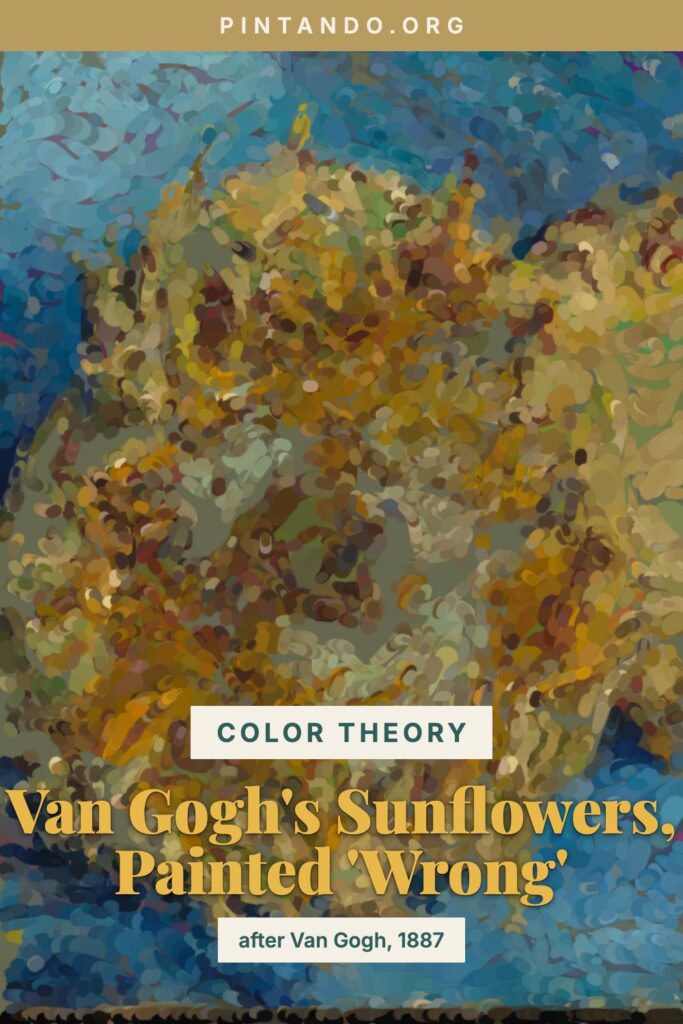
Van Gogh's Other Sunflowers — and Why I Paint Them the Wrong Color
In the video I take a Van Gogh sunflower and start it all wrong: the golden head blocked in a sour olive-green before it warms into the blazing yellow you expect. People recognize "Van Gogh sunflowers" instantly — but this probably isn't the one you're picturing, and that's exactly why I chose it.
When most people say Van Gogh sunflowers, they mean the tall vases of flowers he painted in Arles in 1888, the ones on every tote bag and fridge magnet. This painting comes from a year earlier and a different city. It's quieter, stranger, and in some ways more instructive — because it's Van Gogh practising the color thinking the famous vases would later make immortal. Starting it in the wrong color is a way of practising right alongside him.
The painting: cut sunflowers, Paris, 1887
The Met's Sunflowers was painted by Vincent van Gogh in 1887, during his two years in Paris — not in Arles, and not in a vase. It's one of a series of four still lifes of cut sunflower heads he made in Paris in the late summer of 1887, the blossoms lying on a surface rather than standing in a pot. The painting now lives at The Metropolitan Museum of Art in New York. Two of the smaller works from this group were later owned by Paul Gauguin, who is said to have hung them above his bed in his Paris apartment until he sold his prized possessions to fund his South Seas voyage — a small detail I love, because it means these humble cut blooms mattered enormously to the painters who saw them first.
Paris is the key. When Vincent arrived in 1886 his palette was still earthy and Dutch — the brown world of the Potato Eaters. Then he met the Impressionists and the younger experimenters, saw Japanese prints, and started laying complementary colors against each other to make them vibrate. These cut sunflowers are a laboratory for that new thinking: warm oranges and yellows flowing into adjacent greens, with touches of blue dropped in to make the warmth ring. He's testing what color can do. A year later, in Arles, that test became the famous vases.
Why painters start with the wrong color
The lesson Van Gogh was teaching himself is the one underneath this whole series: complementary colors — opposites on the color wheel — make each other come alive.
Yellow and its cooler opposites are a textbook pair. Set a warm yellow beside a cool note and simultaneous contrast kicks in: the yellow blazes hotter, the cool deepens, each driving the other to its extreme. That's the energy crackling through Van Gogh's sunflower heads. Now bring it into watercolor and add a second layer of the idea. If you underpaint a yellow blossom in a cool, muted green and then glaze the true yellow on top, the yellow ignites against the green breathing through from below — the petals stop being a flat custard blob and start to glow, exactly the emotional charge of color Van Gogh chased his whole short career.
This is the same engine I unpack in the grapes from his 1887 Paris still life, painted in the very same season as these sunflowers — purple grapes underpainted in gold instead of yellow petals over green, but the identical Paris-born logic. Complement underneath, true color glazed over the top.
Try it yourself
A watercolor exercise in yellow-over-green, the Van Gogh way.
- Pick a high-yellow subject. A single sunflower head, or a few lying on a table. Yellow flowers are perfect because everyone knows their color cold, so the olive-green "wrong" phase reads as genuinely, satisfyingly wrong.
- Mix the cool complement. For a warm sunflower yellow, mix a muted, grayed green — a touch of sap or olive green knocked back with a little burnt sienna so it's a quiet, dirty green, not a screaming one.
- Block in the blossom green. Wash the green over the whole flower head, modeling the form — darker at the center disc and in the shadowed petals, lighter where the light catches the edges. Leave the brightest spots as bare paper.
- Let it dry completely. Watercolor demands it: glaze onto a damp green pass and it lifts into mud. Wait for a bone-dry surface before the yellow goes on.
- Glaze the true yellow over the green. Lay transparent yellow over the dried green, thinner where the light hits so the green glows through, denser in the shadowed petals and disc. Watch the petals ignite. Drop a touch of true blue nearby and the yellow rings even louder.
- Finish with Van Gogh's energy. Build the seed-disc with broken, directional strokes, add a few warm-brown and cool-blue accents, and keep your brushwork visible. Van Gogh never smoothed his away — neither should you.
If the petals feel dull, your yellow probably smothered the green completely — pull it thinner and let more of the cool base breathe through. That glow is the painting. It's the same thing Van Gogh found in Paris in 1887, a year before he carried it south and painted the sunflowers the whole world remembers.
What should I paint wrong next — another Van Gogh, or a flower from your own garden? Tell me in the comments. The next one in the series might be your idea.
You might also enjoy these articles: